Best Popup Software for Lead Generation in 2026

Md Hamim Khan
Md. Hamim Khan is the Co-Founder and CEO…
In this article
Lead generation nowadays looks very different from what it was just a few years ago. Users are more privacy-conscious, attention spans are shorter, and generic popups are ignored faster than ever. Yet, popups remain one of the highest-converting on-site tools when they are done right. The difference now lies in intelligence, timing, and experience rather than mere visibility.
Modern popup software is no longer about forcing an email form onto the screen. It is about understanding user intent, adapting to behavior in real time, and delivering value at the exact moment a visitor is most likely to respond.
In this article, we’ll explore the best popup software for lead generation in 2026, what makes them effective, and how to choose the right solution for sustainable growth.
So, without further ado, let’s dig deeper.
Why Popup Software Still Works in 2026
Pop-ups are often described as annoying or outdated, yet in 2026 they remain one of the most widely used and effective on-site conversion tools. The reason is simple: while user behavior has evolved, human attention has not.
When designed with intent, timing, and relevance, pop-ups still generate measurable business results across ecommerce, SaaS, and content platforms.
1. Performance Data: Do Pop-Ups Still Convert?
Recent industry benchmarks show that pop-ups continue to deliver strong results. Typical campaigns convert between three and eleven percent of visitors, while the highest performing ten percent of campaigns often exceed thirty percent and in some cases approach forty percent.
Cart‑abandonment pop-ups remain especially valuable, recovering roughly eight to seventeen percent of otherwise lost transactions. These figures remain well above the performance of static banners and footer forms, which usually convert below two percent.
Conversion performance on mobile devices now averages around 10 to 11%, slightly higher than the nine to ten percent commonly observed on desktop. Full‑screen layouts, simplified designs, and large close buttons have made pop-ups more usable and more acceptable on small screens.
Different popup formats perform very differently. Immediate entry popups usually convert at only one to three percent because they interrupt visitors before interest develops. Timed and scroll-based pop-ups perform better, often converting four to nine percent.
Exit-intent pop-ups frequently reach 6% to 14% because they appear at moments of loss intent. Gamified formats and cart-recovery messages regularly exceed ten percent and can approach or surpass twenty percent in high-performing campaigns.
2. Behavioral Explanation: Why Pop-Ups Still Work
Pop-ups succeed primarily because they interrupt habitual browsing behavior. On modern web pages, users ignore most banners and sidebars. A modal window placed at the right moment forces visual attention and creates a short decision window in which the message is actually processed.
Modern pop-ups rarely appear immediately. They are triggered after time on page, scrolling behavior, cursor movement toward the close button, or cart activity. These signals identify moments when visitors are engaged or about to leave, which dramatically increases the likelihood that the message feels helpful rather than intrusive.
Visitors tolerate interruption when they perceive clear value. Discounts, free resources, exclusive access, and reminders all create an exchange in which attention is traded for benefit. When the offer is relevant, annoyance is reduced and conversion probability rises.
3. UX Evolution: Why Modern Pop-Ups Are Different
Early pop-ups showed identical messages to every visitor. Contemporary systems now personalize by page type, traffic source, browsing behavior, and device category. This contextual targeting reduces friction and improves message relevance.
High-performing pop-ups are intentionally simple. They focus on a single message, one primary call-to-action, and no more than one or two form fields. Prominent close controls and clean layouts further reduce frustration and abandonment.
4. Gamification and Interactivity
Interactive formats such as spin-to-win wheels, quizzes, and scratch cards consistently outperform static sign-up forms. Whereas standard pop-ups typically convert four to seven percent of viewers, gamified versions frequently reach eight to twenty percent or higher. These formats work because they activate curiosity, reward anticipation, and loss aversion. The chance to win and the fear of missing out increase engagement and decision speed.
5. Funnel Impact Diagram
The simplified flow below illustrates how pop-ups influence the conversion funnel:
Visitors (100%)
   |
Engaged Visitors (30%)
   |
Popup Viewers (25%)
   |
Converted Leads or Sales (1.5–3%)
Without pop-ups, many of these engaged visitors leave without ever encountering a meaningful call-to-action.
6. Distribution of Popup-Driven Conversions
Across ecommerce and SaaS benchmarks, exit-intent formats account for roughly one-third of popup-driven conversions. Timed and scroll-based formats contribute close to thirty percent. Gamified formats contribute about twenty percent, while entry pop-ups and miscellaneous formats account for the remaining share.
What to Look for in Popup Software
Choosing popup software in 2026 requires more than comparing templates or pricing plans. The most effective tools are built around behavior-driven logic, flexibility, and performance insights that support long-term optimization rather than one-off campaigns.
Smart triggers and behavioral targeting
High-quality popup software must go beyond time-delay triggers. Scroll-based activation, exit intent detection, inactivity triggers, and return-visitor logic are now baseline expectations. The best tools allow you to stack conditions, ensuring popups appear only when the visitor’s intent is clear and timing feels natural.
Personalization and segmentation capabilities
Generic popups no longer convert at scale. In 2026, the strongest popup platforms allow dynamic content based on user behavior, traffic source, location, device, and page context. Personalization increases relevance, which directly impacts lead quality rather than just raw signup numbers.
Design flexibility and UX control
Modern popup software prioritizes experience as much as conversion. Custom layouts, animations, responsive controls, and brand-consistent styling are essential. The ability to design popups that feel native to your site helps reduce banner blindness and user frustration.
Analytics, testing, and optimization
Popup performance must be measurable. Built-in analytics, conversion tracking, and A/B testing are no longer optional features. The best tools allow you to test triggers, copy, design, and offers continuously, turning popups into a long-term optimization asset rather than a static element.
Comparison Chart: OptinCraft vs Poptics vs Poptin
| Feature | OptinCraft | Poptics | Poptin |
|---|---|---|---|
| Platform Type | WordPress-native | WordPress plugin | SaaS |
| Builder Style | Canvas Builder | Basic editor | Drag-and-drop |
| Page Builder Compatibility | Elementor, Gutenberg, Bricks, Beaver, Brizy, Breakdance | Limited | Platform-agnostic |
| Templates | Extensive | Moderate | Extensive |
| CRM & Email Integrations | Strong + expanding | Strong | Strong |
| Google Sheets Integration | Yes | No | Limited |
| Email Notifications | Yes | No | Yes |
| Webhook Support | Yes | Yes | Yes |
| Multilingual Support | WPML on roadmap | Yes | Yes |
| Automation Tools | Pabbly, Zapier, Slack on roadmap | Pabbly | Yes |
| Data Ownership | Full | Full | Partial |
| Pricing Value | Very high | Moderate | Lower (subscription-based) |
3 Best Popup Software for Lead Generation—Our Favorite Picks
Not all popup tools are built the same. In 2026, the real difference lies in how deeply a tool integrates with your workflow, how much control it gives you, and whether it fits your platform-first strategy. Below are our 3 favorite popup software picks, each serving a different type of business
1 of 3. OptinCraft — The Most Affordable, Feature-Complete Popup Builder for WordPress
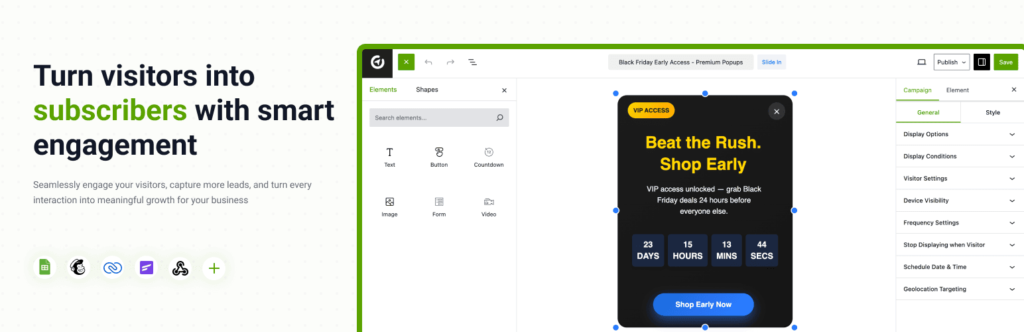
OptinCraft stands out as the most cost-effective popup solution in its category, without cutting corners on features, flexibility, or integrations. It is built specifically for WordPress users who want enterprise-level popup capabilities while keeping full ownership of their data and workflow.
At its core, OptinCraft introduces a Canvas Builder. While it feels familiar like Gutenberg, it is not limited by block-based constraints. The canvas approach gives you free-form layout control, allowing you to design popups exactly the way you want—layered elements, custom spacing, responsive positioning, and conversion-focused structures that work across all screen sizes.
A Truly WordPress-Friendly Environment
OptinCraft lives entirely inside WordPress, making it fast, lightweight, and intuitive for existing site owners. There’s no external SaaS dashboard, no injected third-party scripts slowing down your site, and no forced design limitations. Everything from building to publishing to optimization happens within your WordPress ecosystem.
It is also fully compatible with all popular page builders, including:
- Elementor
- Gutenberg
- Bricks
- Beaver Builder
- Brizy
- Breakdance
- Divi
This ensures OptinCraft fits seamlessly into any WordPress setup, regardless of how your site is built.
Powerful Integrations (Present and On the Roadmap)
OptinCraft already integrates smoothly with essential marketing and CRM tools, including:
- Mailchimp
- FluentCRM
- Zoho CRM
- Google Sheets
- Email Notification systems
- Webhooks for custom workflows and automation
- WooCommerce
- EDD (Easy Digital Downloads)
On top of that, several high-demand integrations are already on the roadmap, such as:
- SureCart
- FluentCart
- HubSpot
- ActiveCampaign
- MailPoet
- Kit (formerly ConvertKit)
- MailerLite
- Zapier
- Pabbly
- FlowMattic
- Slack
- WPML
Templates, Flexibility, and Value
OptinCraft comes with a wide range of ready-to-use templates, covering newsletter signups, lead magnets, promotions, announcements, and more. These templates are fully customizable within the canvas builder, making them suitable for beginners and advanced marketers alike.
What truly sets OptinCraft apart is pricing. It delivers premium-level features at a fraction of the cost of most SaaS tools, making it arguably the most affordable popup software in 2026 that doesn’t compromise on capability.
Best for:
WordPress businesses, agencies, and creators who want maximum control, deep integrations, modern design flexibility, and long-term affordability.
2 of 3. Poptics — A Practical WordPress Popup Plugin with a Focus on Simplicity
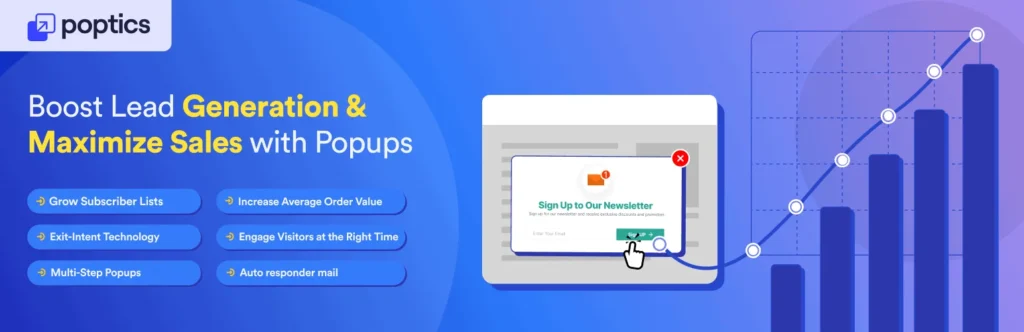
Poptics is a WordPress plugin designed for users who want a straightforward popup solution without the complexity of advanced builders or automation layers. It operates entirely within WordPress, which makes setup and deployment relatively fast.
Poptics supports common triggers such as exit intent, scroll depth, and time-based display rules. Its interface is clean and approachable, making it easy for users to launch basic campaigns without a steep learning curve.
Where Poptics Performs Well
Poptics works best for websites that need reliable lead capture rather than extensive customization. It provides enough control to manage frequency, targeting, and basic segmentation, which is sufficient for many small to mid-sized sites.
While it does not offer a canvas-style builder or deep integration ecosystem like OptinCraft, its strength lies in its simplicity. Users who prefer minimal configuration and faster deployment may find Poptics to be a comfortable fit.
Best suited for:
WordPress users who want simple, functional popups without advanced design or automation requirements.
3 of 3. Poptin — A Mature SaaS Popup Platform for Cross-Platform Use
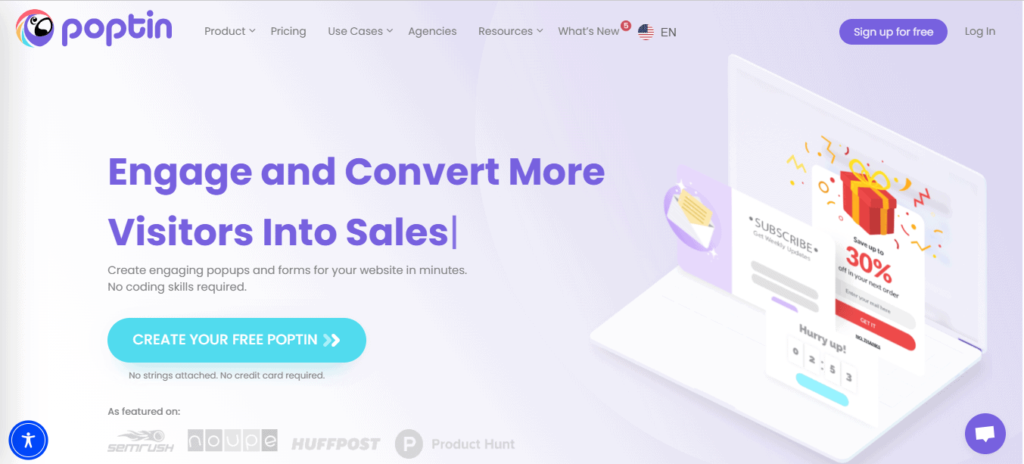
Poptin is a well-established SaaS-based popup solution, built for businesses that operate across multiple platforms. Because it is cloud-hosted, popups are created and managed from an external dashboard and embedded into websites via scripts.
Poptin offers a drag-and-drop builder, a wide variety of popup types, behavioral triggers, and integrations with popular email marketing tools. Its SaaS nature allows it to serve WordPress, Shopify, and custom websites equally well.
Strengths and Considerations
Poptin’s biggest advantage is platform independence. Teams managing multiple sites on different systems can centralize popup management in one place. It also benefits from regular updates and a mature feature set typical of SaaS products.
However, SaaS-based tools naturally come with trade-offs. External scripts, ongoing subscription costs, and reduced control over data and performance can be limiting for WordPress-centric teams, especially those focused on optimization and ownership.
Best suited for:
Businesses operating across multiple platforms that prefer a centralized, cloud-based popup solution.
How to Set Up High-Converting Popups (Best Practices)
High-converting popups are not about being louder or more aggressive but they’re about being timely, relevant, and user-friendly. In 2026, the best-performing popups are those that respect user intent while clearly communicating value. Below are proven best practices that consistently drive higher conversion rates without damaging user experience or brand trust.
Start with intent, not visibility
One of the biggest mistakes with popups is showing them too early. Visitors need context before they are ready to take action. Instead of triggering popups on page load, use behavior-based signals such as scroll depth, time spent on page, or exit intent. These triggers indicate genuine interest and significantly improve conversion rates because the popup aligns with the visitor’s mindset.
When popups appear at moments of intent, they feel helpful rather than intrusive.
Match the offer to the page context
A popup should never feel random. High-converting popups are tightly connected to the content the visitor is already consuming. For example, a blog post about email marketing should offer a checklist, template, or guide related to email growth, not a generic newsletter signup.
Contextual relevance increases perceived value, which directly impacts both conversion rate and lead quality.
Keep the message clear and focused
Effective popups communicate one idea only. A strong headline, a short supporting line, and a single clear call-to-action are usually enough. Overloading popups with multiple offers, long explanations, or extra links creates friction and decision fatigue.
Clarity builds confidence. When users instantly understand what they’ll get and why it matters, they are far more likely to convert.
Design for experience, not disruption
Visual design plays a major role in popup performance. Clean layouts, sufficient white space, readable typography, and subtle animations help popups feel like a natural extension of the page. Aggressive colors, excessive motion, or full-screen takeovers often lead to instant dismissals.
Equally important is providing an easy and visible close option. When users feel in control, they are more open to engaging.
Optimize for mobile first
In 2026, most traffic is mobile. Popups that look fine on desktop but break on smaller screens will hurt conversions and usability. Mobile popups should be compact, fast-loading, and positioned to avoid covering critical content or navigation.
Responsive behavior is no longer optional. Instead, it’s a core requirement for high-converting popups.
Use smart frequency and display rules
Even a great popup can become annoying if shown too often. Use frequency controls to limit how many times a visitor sees the same popup. Consider showing popups only once per session, once per day, or only after a specific action.
Smart display rules protect user experience and ensure your popups remain effective over time rather than being ignored.
Personalize when possible, but keep it subtle
Personalization improves conversions, but only when it feels natural. Segment users based on behavior, page type, or referral source instead of using overly personal details. A popup tailored to “returning visitors” or “pricing page readers” feels helpful, not invasive.
Subtle personalization builds relevance without crossing the line into discomfort.
Test, measure, and refine continuously
No popup is perfect on the first attempt. High-converting popups are the result of ongoing testing and optimization. Test headlines, CTAs, trigger timing, and design variations to understand what resonates most with your audience.
Data-driven adjustments consistently outperform assumptions, especially as user behavior evolves.
Align popups with long-term trust
Finally, always think beyond the immediate conversion. Popups should support long-term relationships, not just email capture. Set clear expectations, avoid misleading copy, and deliver on the promise immediately after signup.
When users trust your brand, conversion rates improve naturally and your leads become far more valuable.
Conclusion
Popup software continues to be one of the most effective ways to turn website visitors into qualified leads when it is used thoughtfully. In these days, success is no longer about showing more popups but about relevance, timing, and a seamless user experience.
Tools like OptinCraft, Poptics, and Poptin each serve different needs. OptinCraft stands out as a powerful yet affordable WordPress native solution, combining a flexible Canvas Builder, strong integrations, and long term value. Poptics offers a simple, practical option for straightforward WordPress setups, while Poptin remains a reliable SaaS choice for businesses operating across multiple platforms.
Ultimately, the best popup software is the one that aligns with your platform and growth strategy. When paired with smart triggers, clear messaging, and user-first design, the right popup tool can become a consistent and sustainable source of high-quality leads.
Frequently Asked Questions ( FAQs)
❓ What is popup software for lead generation?
Popup software lets you create on-site popups to capture visitor information, usually emails, to build your lead lists, promote offers, and boost conversions. These tools often include targeting rules, templates, and analytics
❓ How do popups help generate leads?
Popups grab visitor attention and offer something valuable (like a discount or free resource) in exchange for contact info. They can trigger based on behavior (e.g., exit intent or scroll percentage) to make them more effective than static forms.
❓ Are popups annoying to visitors?
They can be if overused or poorly timed. The best tools let you trigger them thoughtfully like when someone is about to leave, or after they’ve shown interest to reduce annoyance and improve results.
❓ What are common popup types?
Common popup styles include:
✔ Full-screen modals
✔ Sticky bars
✔ Slide-ins
✔ Exit-intent popups
✔ Side messages
These serve different goals like welcome offers, newsletter signups, or promocodes.
❓ Do I need coding skills to use popup software?
Most modern popup tools are drag-and-drop and don’t require coding. You usually just choose templates, edit copy and visuals, and set triggers. Even beginners can use them easily.
❓ Can I integrate popups with my email or CRM tools?
Yes — most good popup platforms let you automatically sync leads to email marketing tools or CRMs like Mailchimp, HubSpot, or Fluent CRM so you can follow up right away.
Share this blog:

About Md Hamim Khan
Md. Hamim Khan is the Co-Founder and CEO of Crafium, leading the company’s vision, growth, and product strategy across its digital and software ventures. With 5+ years of experience in tech and digital marketing, he focuses on building products, driving sustainable growth, and turning ideas into scalable businesses.