If you are looking for the best Shopney alternatives in 2026, three platforms deserve a closer look: AppNatively, AppMySite, and Tapcart.
Shopney remains a popular option for Shopify merchants who want to turn their store into a mobile app without building everything from scratch. But it is not the only choice.
Depending on your priorities, you may want a platform with more design flexibility, broader integrations, AI-assisted app building, stronger native customization, or a pricing model that makes sense for your business.
In this guide, we’ll compare AppNatively, AppMySite, and Tapcart as Shopney alternatives, focusing on the features that matter most when choosing a Shopify mobile app builder in 2026 and beyond.
Quick answer: AppNatively is the strongest overall Shopney alternative for merchants who want a flexible native app builder with visual customization, Shopify integration, AI-assisted workflows, OTA updates, push notifications, and room to connect other platforms and APIs. AppMySite is a strong option for straightforward website-to-app conversion, while Tapcart is particularly well suited to established Shopify brands focused heavily on mobile commerce, marketing, and optimization.
Shopney Alternatives at a Glance
| Platform | Best For | Native iOS & Android | Visual Customization | AI | Push Notifications | OTA Updates | Shopify | Broader Integrations |
| AppNatively | Flexible native app building | Yes | High | Yes | Yes | Yes | Yes | Yes |
| AppMySite | Simple website-to-app conversion | Yes | High | Yes | Yes | Yes | Yes | Yes |
| Tapcart | Established Shopify brands | Yes | High | Yes | Yes | Yes | Yes | Shopify-focused |
The biggest difference is positioning.
AppNatively is a broader native app-building platform, while AppMySite focuses on website-to-app conversion, and Tapcart focuses on Shopify commerce.
What Should You Look for in a Shopney Alternative?
Before choosing another Shopify app builder, look beyond simply generating an iOS and Android app.
A good alternative should answer several questions:
- Is the resulting app genuinely native?
- How much control do you have over the app interface?
- Can you customize navigation and individual screens?
- Does Shopify data stay synchronized?
- Can you send push notifications?
- Can you update the app without repeatedly submitting new versions?
- Does the platform support AI-assisted development?
- Can you connect custom APIs?
- Can the platform grow with your business?
- How easy is App Store and Google Play publishing?
These differences become important once your app moves beyond the initial launch.
1. AppNatively: Best Overall Shopney Alternative
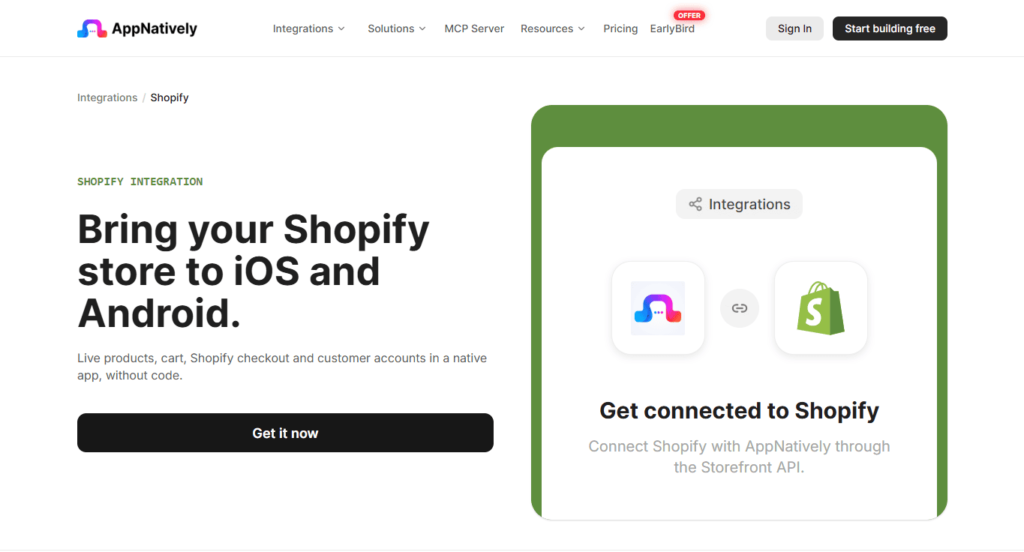
AppNatively takes a slightly different approach from many Shopify-focused mobile app builders.
Instead of treating the app as simply another presentation layer for your store, AppNatively gives merchants a visual native app-building environment where they can customize screens, navigation, components, and app behavior.
It supports Shopify through the Storefront API and can display live products, collections, pages, blog content, carts, checkout, customer accounts, and orders.
Why Consider AppNatively Instead of Shopney?
The biggest reason is flexibility.
AppNatively combines a drag-and-drop builder with native components, Shopify integration, AI-assisted workflows, custom API connectivity, and app management features.
You can build an app visually instead of starting with a fixed template and then customizing the experience around your store.
Key AppNatively Features
Native iOS and Android apps
AppNatively creates native mobile apps for both major platforms rather than simply packaging a website into an app.
This gives Shopify merchants a mobile-first environment for creating their customer experience.
Shopify integration
AppNatively connects to Shopify through the Storefront API.
Products, variants, collections, availability, pages, blog content, cart functionality, checkout, customer accounts, and order information can be incorporated into the app.
One useful advantage is that Shopify remains the source of truth for your commerce data.
Drag-and-drop customization
AppNatively provides a visual builder with production-ready components.
You can work with elements such as:
- Products
- Product queries
- Categories
- Carousels
- Images
- Videos
- Buttons
- Cart components
- Checkout components
- Customer profiles
- Orders
- Wishlist
- Navigation
- And more
This gives merchants considerably more control over the app experience than simply converting a Shopify website into a mobile application.
AI-assisted app building
AppNatively also brings AI into the app-building workflow.
Its MCP integration allows users to connect AI assistants and use conversational workflows to build, customize, and manage aspects of their mobile application.
That is particularly interesting for merchants and agencies that want to move toward AI-assisted app development rather than relying entirely on manual configuration.
OTA updates
One of AppNatively’s notable features is over-the-air updates.
Once changes are published, supported changes can reach users without requiring another App Store or Google Play submission.
That can make ongoing app management considerably easier.
Push notifications
AppNatively supports push notifications for customer engagement, promotions, updates, and other messages. Its Shopify integration documentation notes Firebase-powered push functionality.
Custom APIs
Shopify is not the only backend AppNatively can work with.
The platform also supports custom REST APIs, which can be useful if your store depends on additional services or you want to create an app experience that extends beyond standard Shopify functionality.
Where AppNatively Has an Edge
AppNatively’s biggest advantage is the combination of native app development, visual customization, AI capabilities, Shopify support, OTA updates, and broader backend connectivity.
It is therefore particularly interesting for:
- Shopify store owners wanting more control
- Growing ecommerce brands
- Agencies building apps for clients
- Merchants with custom APIs
- Businesses that want AI-assisted app development
- Teams that don’t want to be locked into a narrow Shopify-only workflow
Who Should Choose AppNatively?
Choose AppNatively if you want more than a basic Shopify-to-app conversion.
It is especially compelling when customization and long-term flexibility matter as much as getting the first version of the app live.
2. AppMySite: Best for Straightforward Website-to-App Conversion
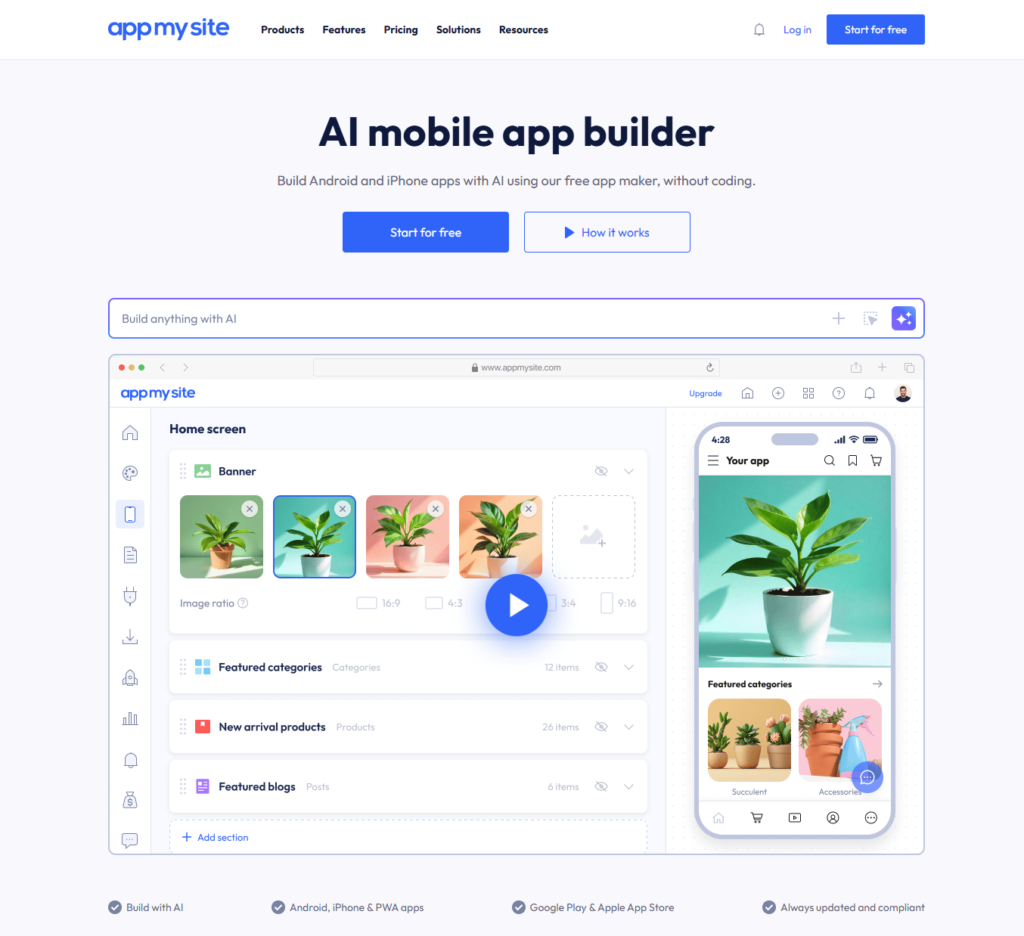
AppMySite is another established alternative for merchants who want to convert a Shopify store into native mobile apps without traditional development.
Its Shopify app builder supports iOS and Android apps, Shopify synchronization, push notifications, app publishing, mobile navigation, and visual customization.
What Makes AppMySite Attractive?
The platform focuses heavily on making the website-to-app process accessible to non-technical users.
You can connect your Shopify store, configure the app, customize its appearance, preview it, and prepare native builds for the App Store and Google Play.
Key Features
Shopify synchronization
AppMySite synchronizes important Shopify data, including products, collections, tags, menus, and other store information.
Push notifications
Merchants can send notifications to bring customers back to the app and promote products, offers, and collections.
Visual customization
AppMySite provides drag-and-drop and toggle-based controls for adjusting the app’s design, navigation, and branding.
App publishing
The platform supports generating Android and iOS builds for publishing to Google Play and Apple’s App Store.
Agency support
AppMySite also offers white-label capabilities for agencies building mobile apps for clients.
Where AppMySite Has an Edge
AppMySite makes sense for businesses that prioritize a relatively straightforward website-to-mobile-app workflow.
It is a particularly reasonable choice if you want:
- A no-code setup
- Shopify synchronization
- Familiar website-to-app conversion
- Push notifications
- App publishing tools
- Agency/white-label capabilities
One important distinction is that AppMySite itself documents both native layouts and WebView screens. Merchants can use native layouts for a more app-focused experience or WebView screens when reproducing website functionality is more important.
Who Should Choose AppMySite?
AppMySite is worth considering if your primary goal is:
“I already have a Shopify store and want to turn it into an app without dealing with development.”
For that use case, it remains a solid Shopney alternative.
3. Tapcart: Best for Shopify-Centric Mobile Commerce
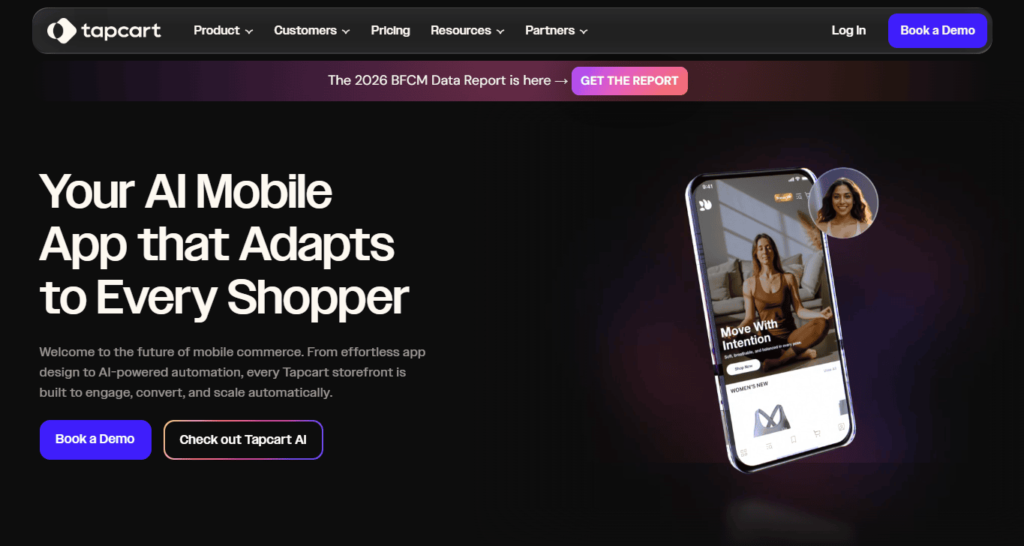
Tapcart takes a more commerce-focused approach.
It is built specifically around Shopify ecommerce and positions the mobile app as a sales, retention, and customer engagement channel.
Tapcart’s platform supports native iOS and Android applications, Shopify synchronization, push notifications, custom screens, integrations, navigation controls, AI-powered editing, and experimentation features.
Key Tapcart Features
Native mobile apps
Tapcart creates native iOS and Android applications specifically for Shopify merchants.
Real-time Shopify synchronization
Products, inventory, images, themes, loyalty data, and other Shopify-managed information can be synchronized with the mobile app.
Push marketing
Push notifications are a major part of Tapcart’s strategy.
Rather than treating the app purely as another storefront, Tapcart positions it as a direct marketing channel for engaging customers.
AI tools
Tapcart also includes AI-powered capabilities within its app-building and marketing ecosystem. Its current feature set includes AI editing and personalization-related capabilities.
A/B testing
Higher-level Tapcart plans include experimentation features such as testing layouts, banners, and calls to action.
Where Tapcart Has an Edge
Tapcart is particularly strong for established Shopify brands that view their mobile app as a serious ecommerce growth channel.
If your team is focused on:
- Mobile conversion
- Customer retention
- Push marketing
- Personalization
- Testing
- Shopify-focused integrations
- Larger-scale ecommerce operations
Tapcart deserves serious consideration.
Its main limitation compared with a broader platform like AppNatively is its Shopify-centric focus. Tapcart states that it currently supports businesses running ecommerce operations on Shopify.
Who Should Choose Tapcart?
Tapcart is best suited to Shopify brands that already have a significant customer base and want to invest heavily in mobile commerce as a dedicated acquisition, conversion, and retention channel.
Which Shopney Alternative Is Best for You?
There is no universal winner. Each platform has a different sweet spot.
Choose AppNatively if:
You want a flexible native app builder that goes beyond basic Shopify conversion.
It is particularly attractive if you care about:
- Native mobile experiences
- Drag-and-drop customization
- AI-assisted development
- MCP
- OTA updates
- Push notifications
- Custom APIs
- Shopify integration
- Broader website/platform integrations
Best overall choice for flexibility: AppNatively
Choose AppMySite if:
You want a straightforward way to convert your Shopify store or website into mobile apps and prefer a mature website-to-app workflow.
Best for straightforward conversion: AppMySite
Choose Tapcart if:
You are an established Shopify brand and want your mobile app to function as a dedicated ecommerce growth and retention channel.
Best for Shopify-focused ecommerce growth: Tapcart
Why AppNatively May Be the Better Shopney Alternative in 2026
The strongest reason to consider AppNatively is not simply that it can create a Shopify app.
Several platforms can do that.
The more important question is:
How much control do you want after the initial app is created?
A basic website-to-app workflow can get your app into production. But as the app grows, you may want to change navigation, add custom screens, introduce new components, connect another API, integrate AI into your workflow, or update the experience without constantly going through the app-store release cycle.
That is where AppNatively becomes particularly interesting.
Its Shopify integration handles the core commerce experience, while its visual builder gives merchants control over the mobile interface. Its support for custom REST APIs and other integrations also gives it room to operate beyond a single Shopify storefront.
For merchants who want a native app platform rather than simply a Shopify app generator, that broader approach can be a meaningful advantage.
Final Verdict
If you’re evaluating Shopney alternatives in 2026, AppNatively, AppMySite, and Tapcart are all worth considering, but for different reasons.
AppNatively is the best overall choice if flexibility, native customization, AI-assisted building, broader integrations, and ongoing app control are priorities.
AppMySite is a strong option for merchants looking for a straightforward no-code website-to-app workflow with Shopify synchronization and publishing tools.
Tapcart is a strong choice for established Shopify brands that want to make mobile commerce a major part of their retention and revenue strategy.
So, if your priority is simply “turn my Shopify store into an app,” all three can make sense.
But if your priority is “build a native mobile experience that I can customize, extend, and manage as my business grows,” AppNatively deserves a closer look.
Frequently Asked Questions (FAQs)
What is the best Shopney alternative in 2026?
AppNatively is one of the strongest Shopney alternatives in 2026, particularly for Shopify merchants who want a flexible native app builder with visual customization, AI-assisted workflows, push notifications, OTA updates, and custom API support.
Is AppNatively better than Shopney?
It depends on your requirements. AppNatively can be a better fit if you want greater control over the app interface, native components, AI-assisted building, custom API connectivity, and a platform that supports more than Shopify.
What is the best Shopify app builder in 2026?
There is no single best platform for every Shopify merchant. AppNatively is a strong all-around option for flexibility, AppMySite is well suited to straightforward website-to-app conversion, and Tapcart is particularly strong for established Shopify brands focused on mobile commerce and retention.
Can AppNatively turn a Shopify store into a native app?
Yes. AppNatively connects to Shopify through the Storefront API and can create native iOS and Android apps with live Shopify products, collections, cart, checkout, customer accounts, orders, pages, and other supported content.
Does AppNatively support push notifications?
Yes. AppNatively supports push notifications, including Firebase-powered functionality, for engaging mobile customers.
Does AppNatively support OTA updates?
Yes. AppNatively supports OTA updates, allowing supported changes to be published to users without requiring a new App Store or Google Play review.
Is Tapcart only for Shopify?
Tapcart currently states that it supports businesses running ecommerce operations on Shopify.
Can Shopify apps built with these platforms be published to the App Store and Google Play?
Yes. AppNatively, AppMySite, and Tapcart support creating mobile applications intended for distribution through Apple’s App Store and Google Play, subject to each platform’s publishing process and the respective store guidelines.
Which Shopney alternative is best for small Shopify stores?
For a small store, the best choice depends on how much customization and long-term flexibility you need. AppNatively is worth considering if you want to start with a flexible native app platform and expand its capabilities as your store grows.
Which Shopney alternative is best for agencies?
AppNatively and AppMySite are both worth considering for agencies. AppMySite specifically promotes white-label capabilities, while AppNatively’s visual builder, native components, custom API support, and broader integrations can be useful when building more customized client applications.