Will AI Make Mobile App Agencies Obsolete?

Md Hamim Khan
Md. Hamim Khan is the Co-Founder and CEO…
In this article
Short answer: No, AI is unlikely to make mobile app agencies obsolete. But it will make some traditional agency business models obsolete.
Artificial intelligence is changing how mobile apps are designed, coded, tested, launched, and maintained. AI coding agents can now generate screens, write functions, create tests, debug code, and help developers move from an idea to a working application much faster than before.
In 2026, AI coding agents have become a normal part of professional development workflows. A 2026 JetBrains developer survey found that 90% of professional developers surveyed were using AI coding agents at work at least weekly, while 68% were using them daily.
At the same time, AI app builders let non-developers create increasingly sophisticated applications without starting from a blank codebase.
So the real question is not:
“Will AI replace mobile app agencies?”
The better question is:
“What happens to mobile app agencies when clients can build more of an app themselves?”
The answer is a major shift in the agency business model.
Agencies that primarily sell coding hours may face increasing pressure. Agencies that sell strategy, product expertise, integrations, UX, security, scalability, maintenance, and business outcomes may become even more valuable.
What Is Changing in Mobile App Development?
Traditional mobile app development often involves a long chain of specialized work:
- Product discovery
- UX and UI design
- Technical architecture
- Frontend development
- Backend development
- API integration
- Authentication
- Testing
- Bug fixing
- App Store and Google Play preparation
- Deployment
- Maintenance
- Feature updates
AI is gradually automating pieces of many of these stages.
Modern AI development tools can generate code from natural-language instructions, assist with debugging, create tests, and help developers work across larger parts of the development lifecycle.
Google, for example, has been pushing toward agentic development workflows, including tools designed to move from prompts toward production applications and native Android development.
That changes the economics of app development.
What once required several people for repetitive implementation work can increasingly be handled by a smaller team using AI-assisted tools.
But that does not mean the entire agency disappears.
It means the agency’s value moves somewhere else.
Will AI Replace Mobile App Developers?
AI will replace some mobile app development tasks, but it is unlikely to eliminate the need for mobile developers.
The distinction is important.
AI is particularly effective at repetitive and well-defined tasks.
For example, AI can help generate:
- UI components
- Boilerplate code
- API requests
- Database models
- Unit tests
- Documentation
- Basic animations
- Form validation
- CRUD functionality
- Error-handling patterns
- Refactoring suggestions
- Debugging assistance
But production mobile applications involve much more than generating code.
A real application may need to handle:
- Complex authentication
- Payments
- User permissions
- Data synchronization
- Offline functionality
- Push notifications
- Security
- Performance
- Analytics
- Third-party integrations
- App Store policies
- Google Play requirements
- Backend infrastructure
- Scaling
- Monitoring
- Privacy requirements
- Long-term maintenance
AI can assist with these areas, but someone still needs to make architectural and product decisions and verify that the resulting system actually works.
Research and industry reporting in 2026 also show this tension. Developers are adopting AI heavily, but trust in AI-generated output remains much lower than usage.
So the future is less likely to be:
AI vs. developers
and more likely to be:
AI + smaller, more capable development teams.
Why Mobile App Agencies Are Under Pressure
The biggest threat to agencies is not AI itself.
It is commoditization.
If an agency’s primary value proposition is:
“Give us your requirements and we will write the code.”
AI can increasingly challenge that proposition.
Consider a simple business application.
A client might previously have needed:
- A designer
- A mobile developer
- A backend developer
- A QA specialist
- A project manager
Today, an experienced developer with AI-assisted tools may be able to accomplish a significant portion of the same implementation work much faster.
AI app builders go one step further by allowing non-technical users to participate directly in application creation.
This creates a new expectation from customers:
“Why should I pay for months of development if modern tools can create a working application much faster?”
That question will become increasingly common.
AI Will Not Eliminate Agencies. It Will Eliminate Certain Agency Work.
This is probably the most important distinction.
AI is unlikely to eliminate the need for every agency.
Instead, it will reduce the value of certain categories of work.
Work Most Vulnerable to AI
These tasks are increasingly easy to automate:
- Basic UI implementation
- Boilerplate coding
- Simple CRUD applications
- Basic API connections
- Standard landing screens
- Simple database structures
- Repetitive testing
- Basic documentation
- Minor bug fixes
- Simple app prototypes
- Routine code refactoring
If an agency makes most of its money from these activities, AI creates a serious competitive threat.
Work That Remains Highly Valuable
Other services are considerably harder to commoditize:
- Product strategy
- Complex architecture
- Security
- Advanced integrations
- UX research
- Business process design
- Performance optimization
- Enterprise deployments
- Data architecture
- Compliance
- App Store strategy
- Long-term product management
- Migration projects
- Complex troubleshooting
- Continuous product improvement
This means agencies need to move up the value chain.
The New Mobile App Agency Model
The successful agency of the future may look very different from the agency of the past.
Instead of selling:
“200 developer hours”
an agency could sell:
“A complete mobile product launch.”
That package could include:
- Product strategy
- UX planning
- App architecture
- AI-assisted development
- Native mobile implementation
- Backend integration
- Testing
- Store submission
- Analytics
- Push notifications
- Ongoing optimization
The technology becomes faster.
The expertise becomes more valuable.
That is a powerful shift.
AI App Builders Are Changing the Economics of Agencies
AI app builders and no-code platforms are particularly disruptive because they don’t only make developers faster.
They make clients more capable.
A founder can describe an application.
A product manager can create a prototype.
A designer can build an interactive experience.
An agency can create multiple client projects without building every component from scratch.
This changes the economics of small agencies.
Instead of hiring a large team for every project, an agency can use a smaller team supported by AI and specialized development platforms.
The result can be:
Lower development costs + faster delivery + more projects per team.
That is not necessarily bad news for agencies.
It can actually create a significant opportunity.
What Happens to Traditional App Development Pricing?
One of the biggest changes may be pricing.
Traditional development often uses a simple formula:
Hours × hourly rate = project price
AI makes the number of hours less predictable as a measure of value.
If AI allows a developer to complete something in 10 hours that previously took 50 hours, charging purely for hours becomes increasingly difficult to defend.
Agencies will therefore have stronger incentives to move toward:
- Fixed project pricing
- Productized services
- Monthly retainers
- Maintenance packages
- Performance-based services
- Strategy consulting
- Specialized implementation packages
The agency’s competitive advantage becomes less about how many hours it can sell.
It becomes about how much business value it can deliver.
Will Clients Build Their Own Apps With AI?
For some applications, yes.
This is already happening.
AI app builders are increasingly targeting founders, entrepreneurs, product managers, designers, and businesses that want to create applications without traditional development workflows.
But there is an important difference between:
creating an app
and
building a reliable product.
A prototype can be created quickly.
A production application requires much more.
It needs to work when real users arrive.
It needs reliable authentication.
It needs data synchronization.
It needs appropriate security.
It needs monitoring.
It needs updates.
It needs a clear deployment strategy.
And it needs someone who understands what happens when something breaks.
That creates an opportunity for agencies.
The Agency May Become the AI-Powered Product Team
Instead of competing against AI, agencies can become the people who know how to use it effectively.
Imagine an agency with:
- 3 developers
- 1 product strategist
- 1 designer
Instead of manually building every component, the team uses AI agents, AI coding assistants, app builders, reusable systems, automated testing, and deployment tools.
That team may be capable of delivering what previously required a much larger organization.
This is where AI becomes an agency multiplier rather than an agency killer.
Where App Builders Like AppNatively Fit
The rise of AI does not mean every business needs to build a mobile application from scratch.
Millions of businesses already have functioning websites, stores, directories, booking systems, and online platforms.
Their problem is often different:
They already have the product. They need a better mobile experience.
This is where specialized mobile app builders can become valuable.
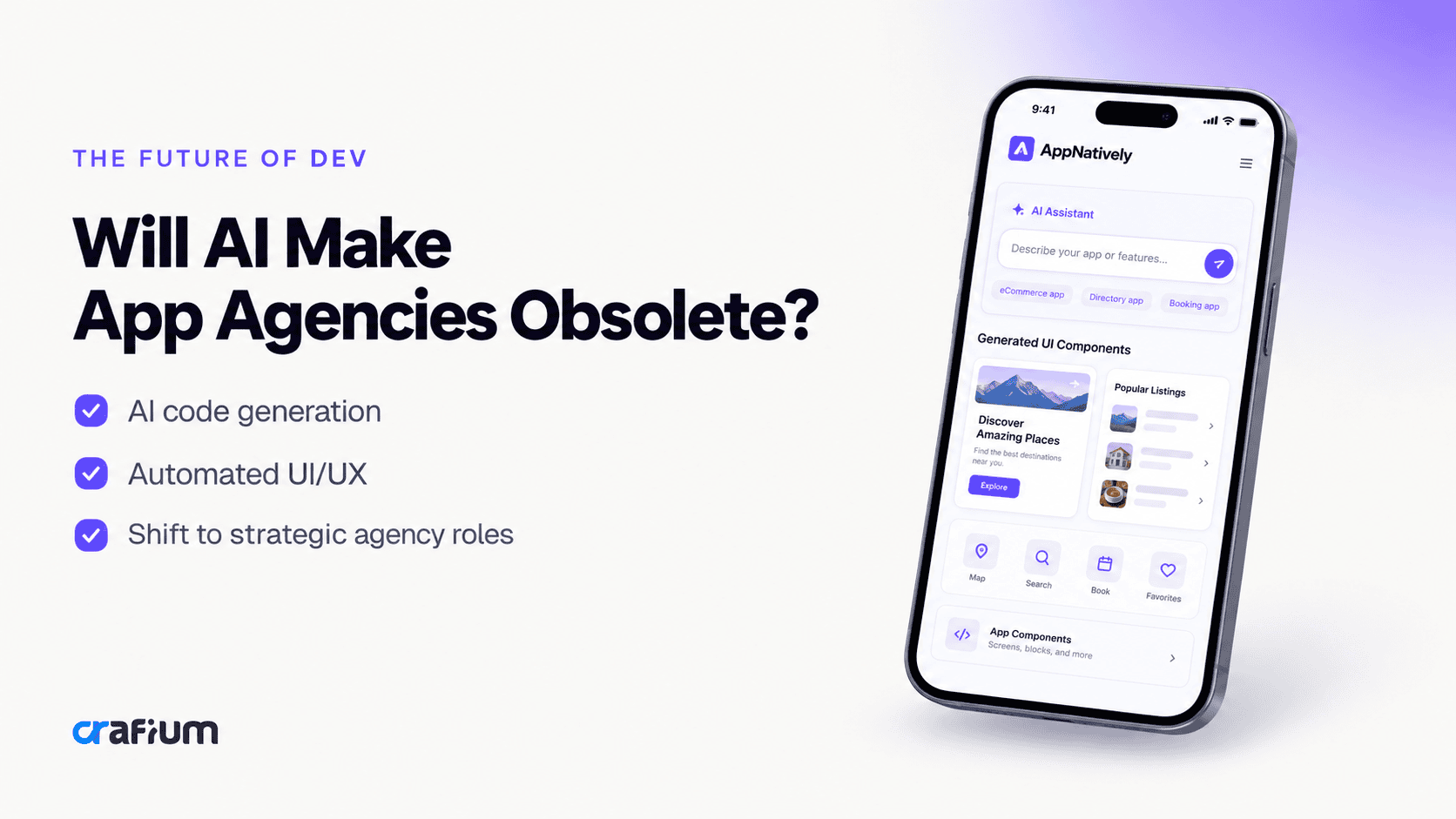
AppNatively, for example, focuses on turning existing websites and digital platforms into native iOS and Android applications without requiring businesses to build everything from scratch.
Instead of starting with a blank mobile project, a business can connect its existing platform and build a mobile experience around it.
That model is particularly interesting for:
- WooCommerce stores
- Shopify stores
- Directory websites
- Booking platforms
- LMS websites
- Restaurant websites
- Membership platforms
- Custom API-based businesses
The larger trend is important.
AI does not always mean generating everything from zero.
Sometimes the smartest approach is using AI and automation to turn existing digital infrastructure into new products and experiences.
AI Could Actually Create More Demand for App Agencies
This may sound counterintuitive.
If app development becomes cheaper, shouldn’t agencies lose business?
Not necessarily.
Lower prices can expand the market.
Think about what happened with website creation.
As website-building tools became easier, more businesses started creating websites.
The market did not disappear.
It expanded.
The same could happen with mobile apps.
Businesses that previously considered a mobile app too expensive or complicated may now decide:
“Why not launch one?”
That creates new opportunities for agencies.
Instead of serving only companies with large development budgets, agencies could serve:
- Small businesses
- Local businesses
- E-commerce stores
- Directory owners
- SaaS companies
- Restaurants
- Booking businesses
- Course creators
- Membership businesses
- Startups
AI can therefore reduce the cost of entering the mobile market while increasing the number of potential customers.
The Rise of the One-Person App Agency
One of the most interesting consequences of AI could be the rise of extremely small agencies.
A solo founder could potentially handle:
- Client acquisition
- Product discovery
- UI design
- AI-assisted development
- Testing
- Deployment
- Support
Specialized tools can handle much of the repetitive work.
The founder’s primary responsibilities become:
Understanding the customer + making decisions + managing the system.
This could create a new category of business:
The AI-native app agency
An AI-native agency may have very few employees but still deliver sophisticated products because its workflow is heavily automated.
The competitive advantage is not having the largest development team.
It is having the best combination of:
People + AI + systems + domain expertise.
What Will Clients Expect From App Agencies in the AI Era?
Client expectations are already changing.
The old expectation was:
“How quickly can you build this?”
The new expectation is becoming:
“Why does this take so long?”
That is a major shift.
Clients will increasingly expect:
Faster prototypes
They will want to see something working early rather than waiting months.
More transparent pricing
If AI reduces development time, clients will question traditional hourly billing.
More customization
Because AI can handle basic implementation, clients may expect agencies to spend more time on unique product requirements.
Continuous improvements
Launching version 1.0 will no longer be the end of the project.
AI integration
Clients will increasingly ask whether their products can use AI agents, automation, personalization, recommendations, or natural-language interfaces.
Agencies that cannot adapt to these expectations may struggle.
AI Will Change the Skills Agencies Hire For
The mobile developer of the future will still need technical skills.
But the skill set will broaden.
Agencies will increasingly value people who understand:
- AI coding agents
- Prompt-driven development
- API architecture
- Mobile UX
- Native application behavior
- Automation
- Product strategy
- Security
- Cloud infrastructure
- AI integrations
- Testing
- Deployment
- Data
The best developers may not necessarily be the ones who type the fastest.
They may be the ones who can:
define the problem → guide AI → evaluate the output → integrate the pieces → ship the product.
That is a very different skill profile.
The Biggest Threat Is Not AI. It Is Refusing to Adapt.
Technology rarely destroys an entire profession overnight.
Instead, it changes what the market considers valuable.
The same thing happened with:
- Desktop publishing
- Digital photography
- Website builders
- Cloud computing
- WordPress
- Low-code platforms
Each technology reduced the amount of manual work required.
But new categories of work emerged around the technology.
AI is likely to follow a similar pattern.
The agencies most at risk are those that continue selling yesterday’s process in a market that now expects tomorrow’s speed.
What Should Mobile App Agencies Do Now?
If you run a mobile app agency, the goal should not be to avoid AI.
It should be to become significantly better because of AI.
Here are five practical moves.
1. Build an AI-assisted development workflow
Identify repetitive work across your projects.
Automate it.
Use AI for:
- Code generation
- Testing
- Documentation
- Debugging
- Prototyping
- Research
- Internal tools
The objective is not to replace your developers.
It is to remove low-value work from their schedules.
2. Productize your services
Instead of selling unlimited customization from day one, create defined packages.
For example:
Mobile MVP Package
E-commerce App Package
Directory App Package
Booking App Package
AI-Powered Mobile App Package
Productized services make your delivery process repeatable and easier to scale.
3. Focus on niches
Generalist agencies compete with everyone.
Specialized agencies can become experts.
For example:
“We build mobile apps for WooCommerce businesses.”
is much easier to understand than:
“We are a digital transformation agency.”
The more specific the problem, the easier it becomes to create reusable systems and workflows.
4. Sell outcomes instead of hours
Clients don’t really want 100 hours of development.
They want:
- More customers
- A mobile presence
- Better retention
- Faster ordering
- Easier bookings
- Better user engagement
- More revenue
The closer your offer gets to those outcomes, the harder it becomes for AI tools to commoditize your business.
5. Become the expert who orchestrates AI
You don’t have to compete with AI.
You need to become better at using it than your competitors.
An agency that combines:
Human expertise + AI + specialized platforms + reusable systems
can potentially deliver faster and at lower cost than a traditional agency.
That is the real opportunity.
Will AI Make Mobile App Agencies Obsolete? The Verdict
No. But it will make some traditional mobile app agency models obsolete.
AI is already changing software development.
AI coding agents are becoming mainstream among professional developers, and AI app builders are lowering the barrier to application development.
At the same time, AI-generated applications still face the realities of production software: architecture, security, integrations, testing, deployment, maintenance, and business requirements.
The mobile app agency of the future will therefore look less like a large team of people manually writing every line of code.
It may look more like a small group of product experts orchestrating AI, development platforms, automation, and specialized technology.
The agencies that only sell coding hours are vulnerable.
The agencies that sell expertise, speed, strategy, product thinking, and measurable outcomes have a different future.
And there is an even bigger opportunity on the other side.
As mobile development becomes easier, more businesses may decide that they can finally afford to build an app.
That means the question isn’t:
“Will AI kill the mobile app agency?”
It is:
“Which mobile app agencies will learn to use AI before their competitors do?”
That is where the next generation of app development businesses will be built.
Frequently Asked Questions (FAQs)
Will AI completely replace mobile app developers?
No. AI will automate many development tasks, but production mobile applications still require architecture, security, product decisions, testing, integrations, deployment, and ongoing maintenance. Developers who use AI effectively are more likely to see their roles change than disappear.
Can AI build a complete mobile app?
AI can generate substantial parts of a mobile application, and some AI-powered app builders can produce working applications from natural-language instructions. However, production readiness depends on factors such as integrations, security, backend architecture, testing, data synchronization, platform requirements, and ongoing maintenance.
Will AI reduce the cost of mobile app development?
Yes, AI can reduce development time for many tasks. However, total project cost depends on the application’s complexity, integrations, security requirements, infrastructure, testing, and ongoing maintenance.
Will mobile app agencies still be needed in 2030?
Likely yes, but their services may look very different. Agencies will increasingly compete on product strategy, specialized expertise, AI-assisted delivery, integrations, security, UX, and business outcomes rather than simply selling development hours.
Should mobile app agencies use AI?
Yes. Agencies should evaluate AI coding agents, AI design tools, automated testing, AI app builders, workflow automation, and other technologies that can reduce repetitive work and improve delivery speed.
Will AI app builders replace custom app development agencies?
For simple and moderately complex applications, AI app builders may reduce the need for traditional custom development. Complex applications will still require specialized architecture, integrations, security, backend systems, and engineering expertise.
Is AI making mobile app development easier for non-developers?
Yes. AI-powered and no-code app builders are lowering the technical barrier to application development. Non-technical founders and businesses can increasingly participate in product creation without writing every line of code themselves.
What is the biggest opportunity for app agencies in the AI era?
The biggest opportunity is to combine human expertise with AI-powered development. Agencies can use AI to reduce repetitive work while focusing their people on product strategy, complex engineering, UX, integrations, security, and measurable business outcomes.
Final Takeaway
AI is not the end of mobile app agencies. It is the end of the idea that app development has to be slow, expensive, and dominated by manual coding.
The winning agencies will adapt.
They will use AI to build faster, specialize in valuable niches, create repeatable systems, reduce unnecessary development work, and spend more time solving the problems that AI cannot solve on its own.
The future belongs neither to AI alone nor to developers alone.
It belongs to teams that know how to make both work together.
Share this blog:

About Md Hamim Khan
Md. Hamim Khan is the Co-Founder and CEO of Crafium, leading the company’s vision, growth, and product strategy across its digital and software ventures. With 5+ years of experience in tech and digital marketing, he focuses on building products, driving sustainable growth, and turning ideas into scalable businesses.