The Future of CRO: Conversion Rate Optimization Trends & Predictions

William Tan
William Tan is a Digital Marketer at Crafium,…
In this article
Conversion rate optimization is entering a smarter, more experience-driven era. As user behavior becomes harder to predict and digital touchpoints continue to multiply, the future of CRO is no longer about isolated tests or surface-level tweaks. It’s about understanding intent, leveraging data intelligence, and optimizing every interaction across the customer journey.
Emerging CRO trends point toward AI-powered experimentation, real-time personalization, and predictive insights that adapt experiences based on user context rather than assumptions. Businesses that align CRO with UX design, behavioral analytics, and automation will see stronger engagement, higher-quality conversions, and long-term growth.
In this article, we’ll explore the key CRO trends and predictions shaping the future of conversion optimization. So, without further ado, let’s dig deeper.
The Key CRO Trends and Predictions Shaping The Next Generation of Optimization
Conversion Rate Optimization is entering a new era where data, design, and intelligence converge. What once focused on simple tests and incremental gains is now evolving into a sophisticated system that predicts intent, adapts experiences, and drives meaningful growth.
The evolution of CRO from testing to intelligence
Conversion Rate Optimization is no longer about running a few A/B tests and tweaking button colors. The next generation of CRO is moving toward intelligent, adaptive systems that learn continuously from user behavior. Optimization is shifting from isolated experiments to a holistic understanding of intent, context, and timing. This evolution reflects how user expectations have changed. Modern users expect relevance, speed, and frictionless experiences across every interaction, and CRO must now meet those expectations at scale.
What once lived purely in analytics dashboards is now deeply connected to UX design, behavioral psychology, data science, and AI-driven decision making. The future of CRO is less reactive and far more predictive.
Hyper-personalization becomes the default experience
Personalization is entering a more mature and nuanced phase. Instead of surface-level personalization such as names or static recommendations, next-generation CRO focuses on real-time experience adaptation. Pages, layouts, messages, and offers increasingly change based on user context, intent signals, traffic source, device type, and behavioral history.
This form of personalization is dynamic and continuous rather than rule-based and rigid. Two users landing on the same page may experience entirely different journeys based on how close they are to converting. The goal is not to overwhelm users with tailored elements but to quietly remove friction by showing exactly what matters to them at that moment.
As personalization deepens, CRO success will depend on how well teams balance relevance with subtlety. Experiences that feel helpful convert, while experiences that feel invasive erode trust.
AI transforms CRO from manual testing to autonomous optimization
Artificial intelligence is fundamentally changing how optimization decisions are made. Rather than relying solely on human-generated hypotheses, AI-driven CRO platforms analyze massive datasets to identify patterns that are impossible to detect manually. These systems can predict which variations are likely to perform best, adjust traffic allocation in real time, and refine experiences continuously.
In the next generation of CRO, AI is not simply accelerating testing but redefining it. Testing becomes less about waiting weeks for statistical significance and more about ongoing learning loops. Human teams shift their focus from execution to strategy, creativity, and interpretation, while AI handles experimentation at scale.
This transformation allows optimization to happen faster, smarter, and with far less wasted effort, especially for high-traffic websites and ecommerce platforms.
Predictive CRO focuses on intent before conversion
Future CRO strategies will increasingly prioritize intent modeling over post-action analysis. Instead of analyzing why users failed to convert after they leave, optimization efforts aim to predict hesitation, confusion, or drop-off before it happens.
Behavioral signals such as scroll depth, cursor movement, dwell time, and interaction pacing help identify where users are in their decision journey. CRO systems then adapt experiences in real time by adjusting messaging, surfacing reassurance, or offering incentives when uncertainty is detected.
This predictive approach reframes CRO from conversion recovery to conversion prevention. Reducing friction before it becomes visible often delivers higher long-term gains than optimizing after losses occur.
Privacy-first optimization redefines data strategy
As global privacy regulations tighten and third-party cookies continue to disappear, CRO is being forced to rebuild around trust and transparency. The next generation of optimization relies heavily on first-party data, ethical tracking practices, and consent-driven insights.
Rather than collecting everything possible, successful CRO teams will focus on collecting the right data. This means prioritizing behavioral context over personal identifiers and building value exchanges where users understand why data is collected and how it improves their experience.
Privacy-first CRO is not a limitation. When users trust a brand, they engage more deeply, convert more confidently, and return more often. Trust becomes a measurable optimization asset.
CRO expands beyond the website into full journeys
Conversion no longer happens on a single page or even a single platform. Modern user journeys span websites, apps, ads, emails, social channels, and customer support touchpoints. The next generation of CRO treats these touchpoints as a unified system rather than isolated optimization targets.
Optimization strategies now focus on continuity and momentum. Messaging consistency, experience handoffs, and timing alignment across channels all influence conversion outcomes. A perfectly optimized landing page can still fail if it disconnects from the ad, email, or social post that brought the user there.
Future-ready CRO teams optimize the journey, not just the destination.
Behavioral psychology moves to the center of CRO strategy
Psychology has always influenced CRO, but it is now becoming central rather than supportive. Next-generation optimization integrates cognitive load theory, motivation models, emotional triggers, and decision heuristics directly into experience design.
Small details such as how choices are framed, how reassurance is delivered, or how progress is visualized can significantly impact user confidence. Micro-conversions like scrolling, expanding content, or interacting with previews are increasingly treated as signals of readiness rather than distractions.
By understanding how users think and feel at each stage, CRO becomes more empathetic and more effective.
Mobile-first optimization becomes non-negotiable
With mobile traffic dominating across industries, optimization strategies that still prioritize desktop experiences are falling behind. The next generation of CRO starts with mobile and scales upward, not the other way around.
Mobile optimization now focuses on speed perception, thumb-friendly interaction zones, minimal input effort, and native-like behavior. Forms become progressive, navigation becomes simplified, and friction points are aggressively removed.
As mobile experiences improve, conversion gaps between desktop and mobile will shrink, making mobile-first CRO a direct revenue driver rather than a secondary concern.
Emerging interfaces create new CRO frontiers
As technology evolves, CRO must adapt to new interaction models. Voice interfaces, augmented reality, and immersive digital experiences introduce entirely new conversion behaviors that cannot be optimized using traditional frameworks.
Voice-based optimization focuses on clarity, conversational flow, and trust signals rather than visual hierarchy. AR experiences reduce uncertainty by allowing users to visualize products in real-world contexts. Virtual environments create emotional engagement that influences purchasing decisions long before traditional conversion points.
The future CRO professional must think beyond screens and clicks, optimizing for interaction modes that are still emerging.
Continuous optimization replaces static testing cycles
The traditional cycle of testing, waiting, and implementing is giving way to continuous optimization models. Next-generation CRO systems learn constantly, refine continuously, and adapt experiences in near real time.
Rather than launching isolated tests, teams deploy living optimization layers that evolve with user behavior. This approach allows experiences to stay relevant even as traffic sources, devices, and user expectations shift.
CRO becomes a living system rather than a periodic project.
Redefining what conversion really means
Finally, the definition of conversion itself is expanding. While transactions and sign-ups remain important, next-generation CRO measures deeper indicators of value such as engagement quality, repeat behavior, content consumption, and long-term retention.
These signals help teams optimize not just for immediate wins but for sustainable growth. A user who engages deeply but converts later may be more valuable than a user who converts quickly and never returns.
The future of CRO is not about maximizing clicks. It is about maximizing meaningful outcomes.
Meet OptinCraft- A Perfect CRO Tool for Business Owners
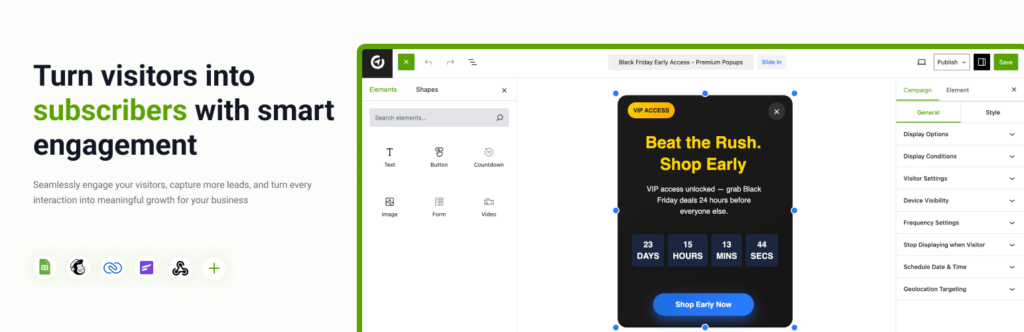
OptinCraft is a WordPress-based conversion optimization tool designed to help business owners turn visitors into leads and customers. It allows you to create highly customizable popups and opt-in forms that appear at the right moment, such as when a visitor is about to leave or after they engage with content. Its visual drag-and-drop editor makes designing responsive popups easy without any coding knowledge, ensuring that campaigns look great on desktop, tablet, and mobile.
The tool emphasizes intelligent targeting, showing the right message to the right visitor based on behavior, page, or device. This ensures popups feel helpful rather than intrusive, increasing the likelihood of conversion. Multi-step campaigns and conditional logic guide users through smaller micro-commitments, building trust and boosting the quality of leads.
OptinCraft also provides real-time analytics, showing impressions, clicks, and conversions across different dimensions. These insights allow business owners to quickly adjust campaigns and improve performance. Integrations with email services, CRMs, and ecommerce platforms make it easy to nurture leads and automate follow-ups.
While it focuses primarily on lead capture and engagement, OptinCraft complements broader CRO strategies by providing actionable, conversion-focused tools that are simple, flexible, and effective. It is particularly suitable for businesses looking to increase sign-ups, reduce abandonment, and maximize engagement without complex systems or steep learning curves.
Final Thoughts
The future of conversion rate optimization is moving beyond simple A/B tests and isolated metrics. It is evolving into an intelligent, predictive, and personalized practice where understanding user intent, behavior, and context drives every decision. Businesses that embrace AI-powered experimentation, privacy-conscious strategies, cross-channel optimization, and behavioral insights will gain a decisive advantage. Mobile-first design, emerging interfaces like AR and voice, and continuous real-time optimization will redefine how conversions are achieved and measured.
Ultimately, CRO is no longer just about clicks or sign-ups; it is about creating meaningful, frictionless experiences that guide users seamlessly toward valuable actions. Organizations that integrate these trends into their strategies will not only increase conversions but also build lasting trust, engagement, and sustainable growth in an increasingly competitive digital landscape.
Tags:
Share this blog:

About William Tan
William Tan is a Digital Marketer at Crafium, specializing in WordPress solutions and online growth strategies. He’s passionate about helping businesses expand their digital presence through smart marketing and data-driven insights.